Rheology through the batch
Record when the material thins, thickens, yields, settles or changes with temperature—and how the available value was measured.
Industrial agitation / Selection guide
Viscosity changes the flow and torque problem, but it does not say whether the batch needs blending, suspension, powder wet-out, wall movement, heat-transfer support or controlled shear.
Selection inputs
The same stated viscosity can behave differently with shear rate, temperature, solids, time or formulation history. Keep the measurement context and batch objective attached to the value.
Record when the material thins, thickens, yields, settles or changes with temperature—and how the available value was measured.
Rank blending, suspension, incorporation, dispersion support, wall movement, heat-transfer support and holding instead of asking one device to “mix everything.”
Include vessel diameter and height, liquid levels, bottom form, internals, additions and draw-off position because the motion occurs inside this geometry.
Flow-direction teaching aid
This independent educational diagram compares idealized axial and radial circulation patterns. It helps a buyer ask how material should move through the vessel; it does not select an impeller or predict a mixing result.
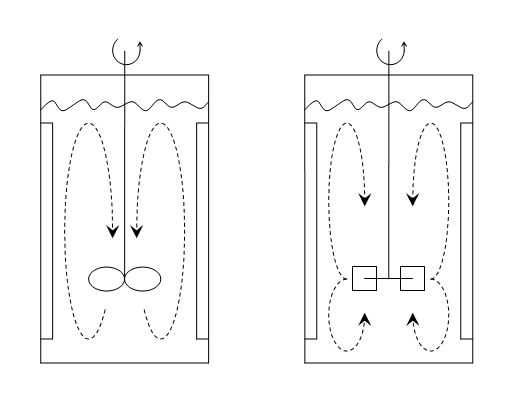
The left sketch represents idealized axial flow; the right represents idealized radial flow. Actual flow depends on the impeller, vessel, baffles, fill level, rheology, solids, speed and operating sequence. This is not JINPIONEER equipment, a supplied configuration, a sizing chart or evidence of mixing, dispersion or scale-up performance.
Diagram by Daniele Pugliesi via Wikimedia Commons, licensed CC BY-SA 3.0. Source JPEG displayed unchanged.
Selection route
This sequence narrows the engineering question without pretending that a generic chart can size the agitator.
Attach temperature, shear or test context to the minimum, normal and maximum conditions.
Choose the result that controls the selection and note any secondary jobs.
Document geometry, working levels, internals, access and discharge path.
Evaluate candidate flow, shear, torque, mechanical and cleaning choices against the full batch sequence.
Agitator-selection RFQ checklist
The goal is to show where the batch resists motion and what the agitation must achieve at that point.
Open the process briefValues or observations by stage, with temperature and measurement context where available.
Shear response, yield behavior, settling, foaming, air entrainment and heat sensitivity.
The mixing result that controls success and how the endpoint is judged.
Particle behavior, loading sequence, addition form and the point where batch behavior changes.
Dimensions, bottom shape, working levels, internals, mounting and draw-off location.
Batch pattern, temperature duty, cleaning, utilities, control method and downstream handoff.
Buyer decision FAQ
No. Viscosity is important, but the required process result, rheology, solids, vessel geometry, fill level, temperature, shear sensitivity and operating sequence also affect the selection.
Provide the range across the batch and attach the measurement temperature and method or shear context when known. Identify the stage that creates the greatest mixing or torque concern.
They describe different process outcomes. Separating them helps the reviewer identify which fluid motion or shear condition controls the arrangement.
List each job in sequence, rank the controlling duty and define its endpoint. A combined arrangement should be reviewed against every stage rather than assumed from the final viscosity.
